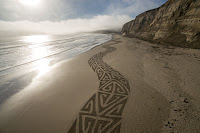
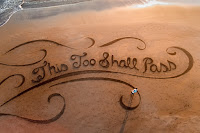
Before the landscape artwork, I did sculptural work. That work turned out to be highly geometric. In studying about the forms I was creating, I stumbled into looking at methods that our ancient ancestors would have used to design their enormous temples and buildings. Crop circles share many of these techniques, and so my eye as drawn there as well. Then, when on the beach sharing what I had been learning with a friend, it suddenly dawned on me what could be possible with a canvas as large as what the beach could offer.
Most of your designs focus on patterns. What is your inspiration for these abstract pieces?
Nature is my ultimate inspiration. For the first few years, the geometric work was my focus as that was my entrance into creating at the large-scale. My studies by this time had turned towards fractals and patterns in nature. My geometric work held a huge issue for me- they felt static, lifeless, whereas these new areas of research felt alive and dynamic. I have always been drawn to nature but could never figure out how to decipher what I was seeing. And then I had an epiphany that in nature there are processes occurring and the pattern we see is the result. For instance, at some temperature threshold the moisture in the atmosphere will precipitate and form a cloud. If the temperature goes up then the water evaporates. If the moisture goes up, rain may occur. Its a dynamic process, which can be appreciated by watching clouds appear, shift, evolve as they float past. The cloud doesn't know what it looks like- it's just appearing as a result of other forces interacting. Think also of ripples in the sand formed by water or wind. Or the way tree growth responds to light- each species in their own way, making their own identifiable yet individually unique profiles in the forest. So I began mimicking this apparent complexity by combining simple processes while working- processes that I could hold together over a large area without having to be specific in any particular way (as I would need to be with the geometric work). In this way the artwork would 'emerge' without specific direction or intent.
These days I have been combining these 'geometric' and 'organic' approaches, acknowledging both the order and chaos side of our existence.
Do you have an idea in mind before you visit a location or do you create pieces on the spot?
For the most part I come to the beach without specific preconception. However, once I have begun work on a new piece I know the process I will follow. So I am not making it up as I go- there is a plan of some sort which allows me to keep it all together over such a large scale. Generally when I arrive at a new location I come ready with various possibilities that I have been working on. Then I decide what would be most appropriate given the conditions of the beach- is the beach wide or narrow, sloped or flat, and so forth. Some designs require more space, some work best when there are natural nooks and crannies to fill in. There are times when I may spend several days at one location in which case I can design for that specific circumstance. There can be a dialogue between the artwork and the landscape,. I can never take for granted how a beach may present- they are all changing throughout the month and year so I must be flexible with what I do.
What is your creative process for each design?
I am always noting and taking photos of patterns I see when out in the world, both natural and human-made, and puzzle over them to understand what is transpiring and what could I learn that could be applied at the largescale. Sometimes an approach I come upon for working at the landscape level will suggests its own possibilities. I'll explore all this in my sketchbook. When a design has evolved into something that feels mature, it goes into a 'pot' of ideas to select from when I am next at the beach. Once able to assess a location in person, I choose the design the works well with the circumstances on the beach. Each design has its own approach. Sometimes I have a better sense of what that will be before beginning, and sometimes the process breaks down in some unforeseen way.
How do you view the ephemerality of your art?
After having done this art for as long as I have, the ephemerality plays less of part in my experience than it did at the beginning. At the start there was a subversive quality to the art. Not that I am special in any way for creating art that isn't meant to last, but as a cultural norm, we view permanence as having more value. But through this art I came to recognize that in the long arc of time, nothing will last- eventually all things I have done and that all humans have ever done will be erased. It had me recognize that at the heart the desire for permanence is a fear of our mortality. How do we choose to spend our time in this limited existence? It is a fundamental question that can be both challenging and inspiring. It took me to the next recognition- what is worth doing other than that which elevates my spirit? That had me allow myself to let the art to take a greater place in my life, investing so much energy in something that almost immediately will begin washing away. My art is a pointer to this larger awareness- to value the life experience as it is happening.
How has your artistic practice changed over time (if it has)?
There are a couple of things I appreciate about the development of my work. At the start of my professional art work, over 20 years ago, I was almost always indoors, often in the near dark due to the sculptures I was constructing, hunched over doing fine, meticulous work. Working outside and at the beach (barefoot!) was a huge and welcome change. And getting physical with my art- using my body as the brush essentially, brought me in much greater connection to my creations.
Is there an artwork you are most proud of? Why?
Yes. 'Flow' is my largest piece that works with the specific landscape. My inspiration was Japanese water painting of a river flowing. I designed it on an aerial photo of the location. Being able to carry through the long curving line as though they were strokes created from way above is quite difficult. For an organic design, I had a specific outcome that looks and feels natural from above, but on the ground its a huge distance and I had to 'feel'.the 'strokes'.
How do you know when a work is finished?
Different designs have different endings. Some need to reach a certain completion. Some can go on and on without end and are finished when my canvas runs out, the waves return, or I'm ready to stop. A design may need a few tries before it achieves completion as a concept..
What is the best thing about being an artist?
I appreciate that I get to be creative for a living, doing it on my terms as expresses who I am. It is gratifying to create work that brings joy, wonder, and inspiration to so many.